
Future-Proof Yourself: Why Personal Branding is Essential in the Age of AI Disruption
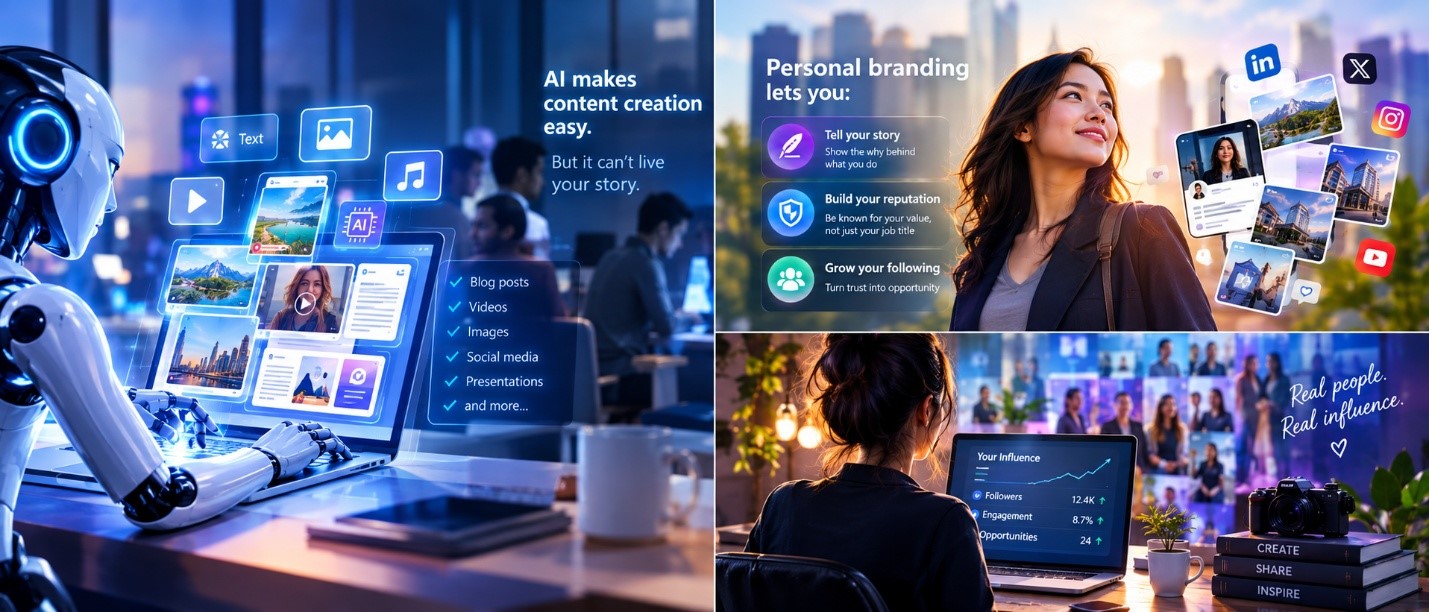
Artificial intelligence is no longer a far-off idea or something reserved for big tech. It's now embedded in tools we use every day, from email assistants and content generators to AI-driven hiring platforms and creative tools. But AI is changing more than how we work. It is changing how people discover expertise, evaluate credibility, and decide who to trust.
As AI makes more skills and tasks easier to replicate, the ability to create something is becoming less rare, while the ability to be recognized for something becomes more important. A 2025 study by the International Labour Organization found that one in four workers globally are in occupations with some exposure to generative AI, with professional and technical roles increasingly affected as AI expands into more specialized tasks. Meanwhile, Adobe's 2026 survey of more than 16,000 creators found that 75% now describe creative AI as integrated or essential to their workflow.
Roles that rely heavily on predictable, repetitive tasks, such as customer service, data entry, and portions of graphic design, are increasingly being streamlined or replaced by automation. But this isn't simply a story about jobs disappearing. AI is also making it dramatically easier to create images, videos, articles, designs, presentations, music, code, and other forms of digital content.
That creates a new challenge. When almost anyone can produce more content, more quickly, simply producing content is no longer enough to stand out. Your perspective, experience, reputation, taste, story, and identity become increasingly important. That is where personal branding comes in.
Why Personal Branding is No Longer Optional
In an AI-powered economy, value isn't determined only by what you can produce. It's increasingly influenced by who you are, what you know, how you think, what you have experienced, and why people should pay attention to you.
Whether you're an artist building a following, a creator turning an audience into a business, a founder building a brand, an independent maker showcasing your work, or a professional building a reputation, the challenge is increasingly similar: How do you make your work, perspective, and story discoverable?
Personal branding is the process of intentionally building that identity and reputation. It can help establish credibility, communicate expertise, attract opportunities, and create a recognizable presence beyond any single platform, job, product, or project. But a personal brand isn't just what you say about yourself. It is also the story people encounter when they discover you. Your digital presence has become part of that story.
AI Makes Creation Easier. That Makes Identity More Valuable.
Think about how much easier creation has become. An artist can use AI to experiment with visual concepts. A creator can generate scripts, images, videos, and ideas. A founder can produce marketing materials in minutes. A designer can explore dozens of directions before choosing one. A professional can use AI to research, write, analyze, and communicate faster.
The tools are becoming more powerful and more accessible, which is a huge opportunity. But it also means the output itself can become less distinctive.
Two people can use similar AI tools and produce technically impressive work. What separates them may not be the tools. It may be their taste, experience, perspective, story, personality, and the meaning they give to what they create.
AI can help you create more. It doesn't automatically make you more memorable. As content becomes abundant, identity becomes a signal.
People don't just follow an image. They follow the artist behind it. They don't just watch a video. They follow the creator whose perspective they recognize. They don't just buy a product. They connect with the story and identity behind the brand. The content may get attention, but the identity gives people a reason to remember who created it.
Why Personal Branding Matters
Authority Beats Automation
AI can generate an answer in seconds, but people still want to know who is behind the idea. Artists build recognition around their style and perspective. Creators build audiences around their voice and personality. Founders build trust around their vision. Professionals build reputations around their expertise and judgment. The more abundant generated content becomes, the more valuable recognizable expertise and identity can become.
Adaptability Equals Resilience
A strong personal brand isn't tied to one job title or platform. Your skills may evolve, your industry may change, and the tools you use may become obsolete. But a reputation can travel with you.
An artist can evolve into a creator. A creator can launch a product. A professional can become a consultant. A founder can build multiple businesses. A recognizable identity gives you something that can evolve as your work evolves.
Opportunities Come to You
A strong personal brand can create opportunities that traditional applications and outbound outreach cannot. People may discover your work through an article, social post, video, project, recommendation, search result, or community. Over time, that visibility can lead to collaborations, clients, partnerships, customers, speaking opportunities, jobs, or entirely new ventures.
The goal isn't simply to become visible. It's to become recognizable for something.
You Own Your Narrative
Your reputation exists whether you actively shape it or not. People will form impressions from your social posts, projects, interviews, articles, portfolio, website, and other digital traces. Personal branding gives you more control over the story those pieces tell together.
Instead of leaving people to piece together who you are from scattered content, you can intentionally communicate your identity, values, expertise, work, and direction. You don't control every impression people form, but you can give them a much better story to discover.
How to Build a Future-Proof Personal Brand
1. Publish Thought Leadership Content
Don't just announce what you do. Share what you think. Write articles, record short videos, explain your process, share lessons, analyze trends, show experiments, document projects, and develop opinions.
Platforms like LinkedIn and Medium allow you to distribute your ideas and build an audience over time. For artists and creators, this can mean showing the thinking behind the work, not just the finished work. For founders and brands, it can mean sharing the ideas, principles, and experiences behind what you're building. For professionals, it can mean demonstrating expertise rather than simply listing credentials.
Over time, these articles, videos, projects, images, and ideas become pieces of your personal brand story. But publishing is only one part of the equation. You also need a place where people can discover the bigger picture.
2. Build a Digital Presence People Can Explore
Don't rely entirely on a single social platform to represent you. Social media is excellent for discovery, but it is not necessarily the best place to tell your entire story.
A post is designed to capture attention in a feed. A profile summarizes who you are. A portfolio showcases selected work. A website can provide a broader digital presence. But a modern personal brand can benefit from something more intentional: a digital presence that gives people a reason to explore.
For an artist, that might include your story, portfolio, exhibitions, process, videos, and social channels. For a creator, it might include your latest work, products, collaborations, videos, community, and contact information. For a small brand, it could combine the brand story, products, media, customer resources, and social content. For a professional, it might include your expertise, projects, articles, credentials, resources, and contact information.
The important question is not simply what you include. It's how you help people experience it.
Someone discovering your work should be able to understand who you are, discover what you create, explore what interests them, and know where to go next. This is where a content portal can offer a different approach.
Instead of presenting your identity as a static profile or a collection of disconnected destinations, a content portal can bring your story, multimedia content, portfolio, social profiles, documents, and calls to action together in one contextual digital experience.
Someone might start with an introduction, explore your work, watch a video, view a project, read your story, and then follow, contact, book, download, purchase, or take another action. The goal isn't to overwhelm people with everything you've ever created. It's to create a guided path through the parts of your identity and work that matter most.
Start with the story. Show the work. Provide context. Give people something worth exploring. Then make the next action clear.
3. Learn AI Tools
You don't need to compete with AI. You need to learn how to use it. AI can accelerate research, brainstorming, editing, design, analysis, coding, content creation, and countless other tasks.
The people who benefit most may not be those who avoid AI, but those who learn how to combine AI's capabilities with their own judgment, experience, creativity, and perspective. Use AI to amplify what makes you distinctive, not to replace it.
The goal isn't to become the person who can produce the most content. It's to become the person whose content people recognize and remember.
4. Build Communities, Not Just Followers
Followers are useful. Relationships are more valuable. Participate in communities where people care about the same subjects you do. Answer questions, share useful ideas, collaborate, give feedback, and help others.
Over time, these interactions build familiarity and trust. A personal brand becomes stronger when people don't just see your content, but recognize your contribution.
Don't Wait for the Market to Force a Pivot
The biggest mistake is assuming your current role, platform, or business model will remain unchanged.
Instead :
- Your expertise can evolve
- Your audience can evolve with you.
- Your digital presence can become an asset independent of any one platform.
- Your reputation can extend beyond your current job, title, product, or business.
- Your body of work can continue creating opportunities long after an individual post disappears from someone's feed.
Personal branding isn't about predicting exactly what the future will look like. It's about making sure people can find you, understand what makes you different, and remember you as the future changes.
Final Thought: Own Your Story Before AI Writes It For You
AI may power more of the future of work, generate more content, automate more tasks, and make expertise easier to access. But it doesn't automatically know your journey. Your experiences are yours. Your perspective is yours. Your taste is yours. Your relationships are yours. Your story is yours.
And in a world where AI can generate more content than ever, that human context can become one of your strongest differentiators.
Personal branding helps turn that identity into something people can discover and remember. But being discoverable is only the beginning. The next question is: What happens when someone discovers you?
From Personal Brand to Digital Experience
A strong personal brand gives people a reason to remember you. A strong digital presence gives them somewhere to explore that story.
That is where content portals can go beyond static profiles and collections of information. A content portal can bring together your story, work, multimedia content, and next steps in a focused digital experience.
It can function somewhat like a lightweight microsite, but with a more focused purpose: creating an interactive experience around your identity and content rather than simply presenting information.
Netblitz takes this approach with interactive content portals designed to help people discover your work, explore your story, engage with your content, and take action. A portal can bring together videos, images, galleries, PDFs, social profiles, forms, contact information, and calls to action in one contextual experience.
For an artist, that could mean turning an individual artwork into an entry point to the artist's larger story, portfolio, process, and body of work. For a creator, it could turn a piece of content into a deeper experience around their work, products, collaborations, and community. For a founder or small brand, it could bring the brand story, products, media, and customer experience together in one place.
Professionals can use the same approach to bring their expertise, projects, resources, and reputation together.
The common thread is that your digital presence should do more than prove that you exist. It should help people understand why you matter.
In an age when AI can generate more content than ever, the opportunity is not simply to publish more. It's to build a recognizable identity, tell a meaningful story, and create a digital experience that makes your work worth discovering.